Weaver and sculptor. I work in natural and recycled materials and make every effort to understand the places and people I work with. I create work in collaboration with other makers, practitioners and communities
30 March 2023
Slow Art Day 2023
06 September 2022
Learning from the collection at Adams Heritage Centre, Littleport
Earlier in the year I was invited by Jenny Stevens to be part of the Queen Drawers at Adams Heritage centre, Littleport Celebrations for the Queens Platinum Jubilee in June 2022.
Along with other artists, I spent some time looking round the shop, which I had been very familiar with as our local hardware shop for many years, but not with the collection that had been stored in cupboards and hidden for so long.
The transformation into a heritage centre for Littleport has been great to see and be a small part of, both as artist and participant in events.
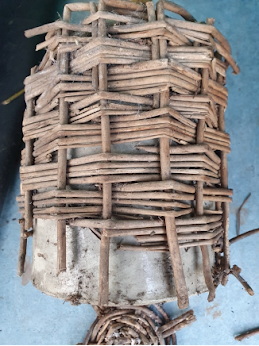
In a dark corner of Adams Heritage Centre there was an old stoneware flagon with a basket container, presumably to prevent breakages when carrying it on a horse and cart.
The willow had been eaten by woodworm and rotted in places, but it still looked fascinating. I was given permission to take it to my workshop and find out whether I could replace the original. I began to learn a lot, both about the techniques and making process, the people involved and the history behind the item.
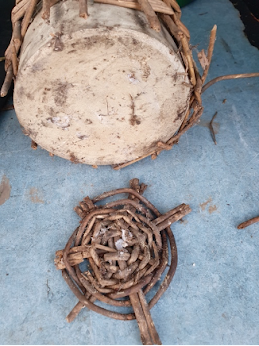
I had noticed the base was not made as I usually start them and it would be interesting to learn; like industrial archaeology I took it apart carefully and kept as much as possible of the original to copy the techniques.
The centre of the base is made from 4 sticks, the 4th is also the first weaver for the base, this makes a sturdy base and is very efficient on time and materials, an essential consideration when hand making anything. The maker was obviously a careful person, very likely a man because most basketmakers were men until relatively recently. He would be able to make about 8 of these flagon baskets in a day, an order for the pub or coaching inn would be 3 or 4 days work.
The top of the orginal basket had to be cut off, which told me it was made round the bottle, not separately. This is harder than making an ordinary basket as you can’t get inside to trim or hold the work in progress.
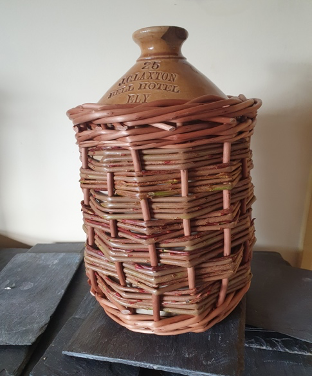
The border of the basket holds the flagon tight and goes onto the angled edge, so it cannot slip out. Ask any basketmaker and they will tell you borders are tricky, so making one that fits so well takes a bit of time to learn. I had three attempts before it worked well enough for me to show anyone the finished piece.
I couldn’t tell whether there had been a carrying handle for the basket, but it is likely there was one. Handles break sooner than any other part of a basket because of everyday use.
The story behind the flagon and it’s basket is still not told, it has the name The Bell Hotel, Ely and number 25 stamped on the top. Maybe it was part of a farmer’s regular order for field workers or used by a coachmen who used the Bell Hotel, we will probably never know. At some time it came to Adams and Sons, in Littleport, and has been there a long time.
Before I started to make the replacements basket I cleaned the flagon, as I washed it out there was what looked like fluff and cobwebs floating to the top. It turned out that there were the bodies of 10 mice, desiccated and long dead! Perhaps they went in to get the dregs of beer, or maybe it was a set trap with grain or poison in.
Adams sold chicken food and grain, there were mice and rats in the shop taking advantage of the food source and there are still signs of them in the floorboards, which have been carefully restored to show more than a hundred years of the building’s history.
https://www.adamsheritagecentre.co.uk/cutlacks-and-the-jh-adams-timeline
The restored flagon and basket is now back in Adams Heritage Centre, sharing it’s story along with all the other items in the collection.
I took three attempts and 1.5 hours to make the finished one, so I would not be able to make 8 in a day. I would not earn enough to feed a family, basket makers have never been rich!
I have learned from experience it takes a lot of energy, time and the right skills to have enough willow to make baskets and sculpture throughout the year.
Preparation of willow includes maintaining and growing willow, grading into the right size for the jobs in hand and soaking to make it pliable for working with as each order or commission comes in.
Each basketmaker working full time needs approximately 2 acres of willow a year, it is harvested in winter. This would have been part of the seasonal life of basketmakers and would need two or three families working together.
In the past willow copses were a familiar and essential part of most farms, providing material for baskets and hurdle fencing used as temporary fencing for cattle and sheep on the farm and in markets.
Since the 1970’s growers have developed into large farms providing willow for makers, who can have their order of willow delivered or go to the farms to collect their supplies.
The farms also grow willow for wonderful drawing charcoal, made by baking in large ovens and supplied to schools, colleges and artists round the world.
I continue to learn and listen to the stories of makers I can never meet, they tell me their stories through the pieces they made.
31 July 2022
Reflecting on work and life habits
After the longest gap between posting for the blog, this might be the beginning of regular writing. Reflective practice, not just doing admin.
Part of the process is seeing older work and maybe recycling it, maybe renewing it, sometimes removing it althogether.
This summer has been the busiest for over a year. Meeting more people and travelling further than I have for over three years, the process of going back to 'normality' was very interesting. I think choices need to be made, not always habits returned to.
Completing commissions, delivering commissions, and training sessions face to face feels much more challenging than when it was a 'normal' habit.
Considerations include how to choose priorities, Who, where and what to work with.
I made the choice of limiting the number and frequency of willow workshops, this enables me to spend time in the workshop refining my own making practice. The advantage for students is that they benefit from my more considered approach to making, using better-selected materials and more precise techniques.
03 May 2021
Updating and meeting people!
Tomorrow will be the first full day of working on-site with more than 6 students for over a year, a big step from working alone for so long.
It feels like a huge adventure and I am excited to be doing a training day for Learning Through Landscapes at Huntingdon Primary School.
The weather might be challenging, it's promising to be the first wet day for at least 4 weeks! But that is good practice for teachers learning how to provide a school curriculum outdoors.
I will report back with photos!
03 November 2020
Concentrating, reading, drawing and less skimming
This time has been so strange. My habits of skim reading and 3 minute concentration time had taken over.
06 April 2020
Slowing Down, taking time
I started writing about Slow Making in 2006, for several years I have not had time or been in the right place to concentrate on ideas or writing. Now seems the right time to revisit and refine the thinking. On Slow Art Day I have been looking at some of my studio stock in a different light.
I do not own any of his art work or have any of his clothes, textiles or printed material so most of the time was spent online.
What I do own are yarns which were developed as prototypes in the workshops of The Scottish College of Textiles. I have memories of lecturers and technicians at the college being somewhat surprised and dismissive of the yearn developed in the workshops. Bernat was not really interested in the traditional techniques and machinery used to produce yarns. Bernart was far more focussed on fibres for their texture than useful properties. Where technicians like to make sure things work and will be long lasting, his priority was always the appearance and effect on the garment. The yarns were sometimes fragile and unstable as a result, but were fabulous colours and combinations of fibre and textures.
Bernat Klein had also worked with The Dovecot studios, with amazingly skillful weavers who collaborated on his designs for tapestries. A result of doing this little bit of research into the work has highlighted a lot of wonderful reference material, including panel discussions at the Dovecot in 2015, when a retrospective "A Life in Colour" was staged there.
I met him and visited 'High Sunderland', the wonderful commissioned house and studio in the 1970's as a post graduate student at the Scottish College of Textiles. I wanted to understand more about the development processes and techniques of making, much more interested in that than selling work or being famous.
He was a delightful man, but even then I realised he could be somewhat annoying to those who had to live with him. Passionate and prolific about his work, he had become very successful working with famous fashion and textile designers and architects.
When I met him he had become a skilful painter, using colour in ways others did not seem to achieve. He did not seem limited by the need to portray realism, his passion was purely about colour and atmosphere.
For a few weeks my weaving was very influenced by Bernat Klein. amples from upholstery cloth, Donegal yarn. Woven in 1978
https://thevintagetraveler.wordpress.com/2014/04/29/bernat-klein-1922-2014/
http://hippystitch.blogspot.com/2015/08/bernat-klein-life-in-colour-dovecot.html
http://staging.nms.ac.uk/explore-our-collections/stories/art-and-design/bernat-klein-collection/
01 April 2020
Slow Art Day
I still haven't decided what my Slow Art choice will be, I seem to take longer to make decisions, but that's ok too!
31 March 2020
Life has changed, the world feels different
With all that is going on just now I can say I am truly grateful for many things. Including family, friends and clients and of course my health.
These are such uncertain times, I think we need to be kind to ourselves and others. I can't remember when we last had time to think and just be, so try to take advantage of this time. Allow yourself to feel whatever it is you feel, do whatever you feel like doing or not doing. Just sit and watch the natural world, trust that all will be well, all is well, and hard as it is at this moment, I am sure there will be good and creative times ahead.
So far I have cleared my little allotment copse, keeping it clear of some weeds and making good use of the early nettles to make salads, soups and pesto, with the wild garlic growing alongside it makes a wonderful early salad! I have also been cutting the holes in the plastic bigger for the plants that were planted several years ago. Over time, as the willow stems grow bigger, the plastic does not expand any further, so they need cutting to enable future growth. I am also pulling all the briars from the older willow beds, they are just budding at the moment and I hope will produce better harvest for being cared for.
I am really thankful for the community of makers, student s and colleagues, it is always a pleasure to run workshops and collaborate. I will be holding everyone in mind, if there is anything I can help do get in touch. I am here.
I have also had spent some time to refine skills in the workshop and studio, developing some new pieces of work and reading all the books that are either left half read, or unread because of other demands on my time. I trust the results of this will be seen in the work that you see or the workshops you take part in future.
02 December 2019
Making to brighten dark days
06 November 2019
New shapes for this season
30 September 2019
Looking forward to sharing stories


30 August 2019
New and familiar people, places and seasons
The theme Grandad's Island comes from a lovely children book by Benji Davies, its about a journey and sharing memories.
I will be making alongside students and volunteers. Participants in workshops will learn how to weave and make sculptures with willow so if you are reading this and think it's something you want to do email volunteer@artillery.org.uk
My design is like an upturned boat, that may have landed recently or a long time ago - depending on the story you tell.
07 August 2019
Summer busy-ness
Riverside Arts are a group of eight artists working together provide a good variety of work to visit as part of Cambridge Open Studios. We have worked together for several years and developed a welcoming atmosphere for visitors of all ages. Thank you everyone for your support
Some of the visitor comments this year were really encouraging
'What a find! A wonderful combination'
'Wonderful space and exhibition'
'Wonderful experience to see so much inspirational art'
'We loved our now annual visit to your studio...favourite is the Antler Moth (Kimberley Allens work)...Very inspiring and a lovely range of work'
'It was lovely to see a variety of talent in one exhibition'
Riverside Arts artists have work in our local, and exceptionally good, Spanish restaurant Habis. The work is for sale and you can enjoy refreshments, great coffee or tea and fabulous cakes while you make a choice from which artists work you like. The artists will work to commission, always a pleasure to make work for a particular setting or special occasion.
23 June 2019
News, updates and information
FrostArt workshops now has online booking and payments available. I am so excited about this and you may have been waiting a while for it to happen!
Workshop dates at WWT Welney are currently available on the events page
Make a choice from the survey for the workshop selection I look forward to working with you very soon.
If you have any queries or there are problems with your bookings please contact me
Invite friends and family to come to a workshop with you, include the link in the invitation so they have the details in front of them.
18 June 2019
A new viewpoint
![]() |
| Evening sunshine helped. Photo by Tim Frost |
![]() |
| Evening sunshine helped. Photo by Tim Frost |
![]() |
| Evening sunshine helped. Photo by Tim Frost |
10 June 2019
Open Garden conversations
I met people who came on the train from Cambridge, some taking time to visit Ely from London, Manchester, Sheffield and Australia. Very varied life experiences, but so many links, shared hopes and dreams for the lives of people, wildlife and the planet.
This was also the last day of the Moon exhibition in Ely Cathedral so the conversations extended to the further still.
03 June 2019
Prickwillow work in progress
More to follow and work will be developed during the month, which is promising to be a busy one.
I will be 'in residence' in the greenhouse of The Bishops Garden preparing for Sunday 9th, Open Gardens in Ely This will be a preview of the planning and making of work for several exhibitions this year, some work will be available for sale.
The following weekend I will be in Bury St Edmunds, again linked to an open gardens trails, for 'Tracks and Traces' exhibition where work will be available for sale.
09 May 2019
Background work
This update should mean I work more efficiently for teaching and really enjoy more focussed and productive studio time. Now to go and handle more natural stuff.
08 May 2019
Familiar work, different setting
06 May 2019
New venue
When visiting you are likely to meet the lates additions to their growing flock of sheep, these supply both wool and meat products to the shop.
I have provided Olivia with a small selection of willow work to have in the shop, with the aim of encouraging customers to commission pieces to suit their special occasions and events.